A Water Purification System turns questionable water into water suitable for a specific use. That use may be drinking, cooking, manufacturing, or laboratory work. The system does not simply “clean” water in one step. It manages different contaminants through carefully selected treatment stages.
Peter H. Gleick, co-founder of the Pacific Institute and a respected water scientist, describes water as “the most precious resource on the planet.” His statement gives this technology real context. A purification system protects that resource while reducing risks from sediment, bacteria, chemicals, heavy metals, and unpleasant odors.
The process usually begins with screening or sediment filtration. This stage removes visible particles, such as sand and rust. Activated carbon can reduce chlorine, odors, and some organic compounds. Membranes, including reverse osmosis, separate many dissolved substances. Ultraviolet light may then deactivate microorganisms without adding chemicals.
The details matter.
Not every system removes every contaminant. That is an important limitation. A household filter may improve taste but fail to address nitrate contamination. A reverse osmosis unit may produce highly treated water but waste part of its feed water. Maintenance also affects performance. A clogged filter can reduce flow and weaken protection.
This guide explains how a Water Purification System works, what each stage does, and where common assumptions fail. It also considers testing, maintenance, installation conditions, and the standards that support safer decisions. Clear water is not always safe water. Testing remains essential.
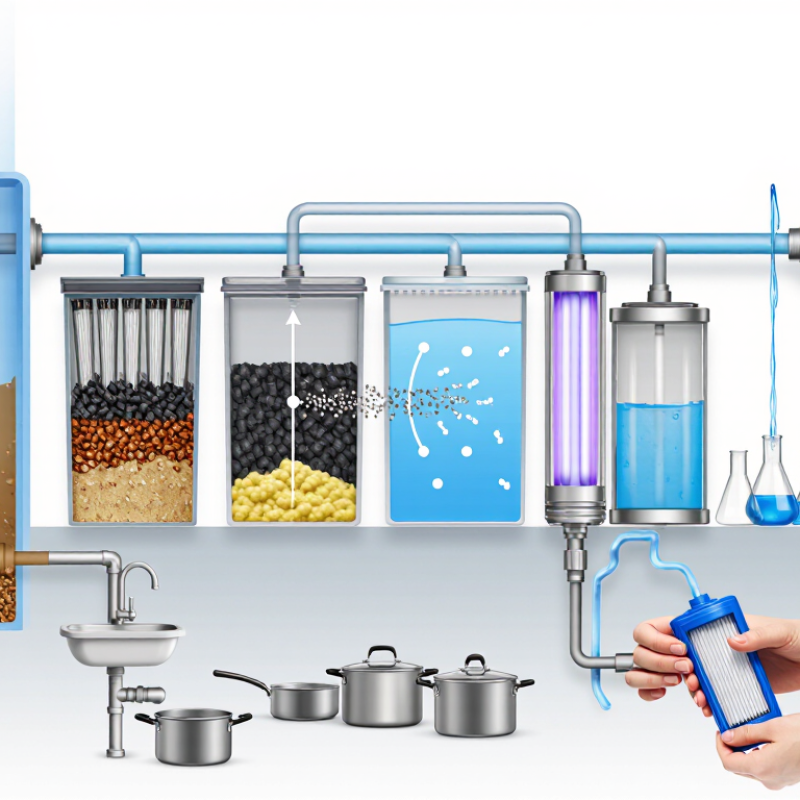
A water purification system is a set of processes that makes water safer for drinking, cooking, or industrial use. It removes or reduces unwanted substances, including sediment, bacteria, viruses, chemicals, and unpleasant tastes. The system may treat municipal water, groundwater, rainwater, or wastewater. Its design depends on the water source and the contaminants found.
A typical system begins with screening or sediment removal. Coagulation can gather tiny particles into larger pieces. Sedimentation then allows those particles to settle. Fine filtration captures smaller impurities, while activated carbon can reduce certain odors and organic compounds. Disinfection, often using ultraviolet light or carefully controlled chemicals, targets microorganisms. Reverse osmosis can reduce many dissolved salts, but it also creates reject water. Every stage has limits.
The World Health Organization reported that 2.2 billion people lacked safely managed drinking water in 2022 (WHO/UNICEF Joint Monitoring Programme, 2023). That figure shows why purification is not merely a technical convenience. It is a public-health measure. The U.S. Environmental Protection Agency notes that treatment performance depends on source-water quality, maintenance, and proper operation. A clean-looking filter may still be ineffective. That is easy to miss. Replacing cartridges, checking flow, and testing treated water are practical safeguards. Some household systems are installed too quickly, without testing the incoming water first. That is a weakness worth acknowledging. A purification system should be selected from evidence, not from impressive claims or a single laboratory result.
Clean-looking water is not always safe water. Sediment, bacteria, dissolved metals, pesticides, and unpleasant odors can remain invisible. A clear glass proves very little. Water quality can also change after flooding, pipe repairs, or long storage. That is why purification matters, even when water tastes normal.
A water purification system removes or reduces unwanted substances through several treatment stages. A sediment filter may catch sand and rust. Activated carbon can reduce chlorine, odors, and some organic chemicals. Membrane systems can lower dissolved salts and microscopic contaminants. Disinfection methods, including ultraviolet treatment, can help control certain microorganisms. Each method has limits. No single unit removes everything.
Reliable treatment begins with testing the water source. A private well may need different protection than municipal water. Testing can identify hardness, lead, nitrates, or microbial concerns before equipment is selected. Certified performance data is more useful than vague advertising claims. Maintenance matters too. Filters become less effective when they are overdue for replacement, and neglected equipment may create new hygiene concerns. I have found that people often focus on installation and forget daily upkeep. That assumption is risky. Regular testing and clear maintenance records offer stronger protection than appearance alone. Purification is not a one-time promise. It is an ongoing water safety practice.
A water purification system removes or reduces physical, chemical, and biological contaminants. The process normally begins with source-water testing. Technicians check turbidity, acidity, dissolved minerals, and microbial indicators.
The World Health Organization and UNICEF reported that 2.2 billion people lacked safely managed drinking water in 2022. That figure shows why treatment must be measured, not assumed.
Water first passes through a coarse screen. It catches leaves, grit, and other visible debris. During coagulation, treatment chemicals help tiny particles join together. Gentle mixing forms larger clusters called flocs. The water then enters a settling tank. Gravity pulls most flocs downward, leaving clearer water above.
Next, filtration removes smaller particles. Common media include sand, activated carbon, or specialized membranes. Carbon can reduce certain tastes, odors, and organic compounds.
Membranes may block microbes, salts, or fine suspended solids, depending on their pore size. The final barrier is disinfection.
Ultraviolet light, ozone, or carefully controlled disinfectants can reduce remaining pathogens. The U.S. Environmental Protection Agency identifies filtration and disinfection as important treatment barriers, but performance depends on correct operation.
The job is not finished there. Storage tanks and pipes can reintroduce contamination. A clear glass is not proof of safe water. Poor maintenance remains a weakness in many systems.
Testing schedules, filter replacement, and operator records provide stronger evidence. No purification method removes everything equally, so the treatment design must match the actual water analysis.
A water purification system removes or reduces unwanted particles, chemicals, minerals, and microorganisms. Its performance depends on the source water and the treatment sequence. Clear water is not always safe water. Some contaminants have no smell or visible color.
Sediment filters capture sand, rust, and suspended particles. Activated carbon can reduce chlorine, unpleasant tastes, and some organic compounds. Reverse osmosis pushes water through a fine membrane under pressure. It can reduce dissolved salts, lead, fluoride, and many other contaminants. However, it also removes useful minerals and produces wastewater. Distillation boils water, then collects condensed vapor. This method is effective, but it usually consumes more energy. Ion exchange softeners replace calcium and magnesium with other ions. They help control scale, but they are not complete purification systems.
Ultraviolet treatment damages microorganisms using light. It does not remove chemicals or sediment, so prefiltration matters. Disinfection may also use carefully controlled chemical treatment, especially in larger systems. Each technology has limits. A system designed without water testing may solve the wrong problem. In practice, reliable treatment starts with laboratory analysis, regular filter replacement, and maintenance records. Small leaks, exhausted cartridges, or poor installation can weaken results. This part is often overlooked. Testing purified water periodically remains wise, even when the equipment appears to work normally.
| Purification Method | How It Works | Common Contaminants Reduced or Removed | Best-Suited Applications | Key Advantages | Important Limitations |
|---|---|---|---|---|---|
| Sediment Filtration | Uses a porous physical barrier to trap suspended particles as water passes through the filter. | Sand, silt, rust particles, dirt, and other visible or larger suspended solids. | Pre-treatment for household, commercial, and industrial water systems. | Simple operation; protects downstream filters and equipment from particle loading. | Does not reliably remove dissolved chemicals, salts, viruses, or most microorganisms. |
| Activated Carbon Adsorption | Water flows through porous carbon, where certain compounds attach to the carbon surface through adsorption. | Chlorine, many taste- and odor-causing compounds, and some organic chemicals. | Improving drinking-water taste and odor and reducing chlorine-related issues. | Can improve water quality without adding chemicals; effective for many organic compounds. | Performance varies by contaminant and contact time; exhausted carbon can lose effectiveness and requires replacement. |
| Microfiltration | Pressure forces water through membranes with very small pores that physically retain suspended particles and some microorganisms. | Suspended solids, bacteria, protozoan cysts, and some larger particles. | Clarification and microbial reduction when dissolved contaminants are not the main concern. | Produces clear water and generally operates at lower pressure than tighter membrane processes. | Usually does not remove dissolved salts, many dissolved chemicals, or viruses consistently. |
| Ultrafiltration | Uses pressure-driven membranes with smaller pores than microfiltration to retain fine particles and many microorganisms. | Suspended solids, colloids, bacteria, and many viruses, depending on membrane performance and integrity. | Drinking-water treatment and pre-treatment for more advanced membrane systems. | Provides strong particulate and microbial reduction without phase-changing the water. | Does not generally remove dissolved salts and some low-molecular-weight chemicals; membranes need cleaning. |
| Nanofiltration | Uses a semi-permeable membrane that allows water to pass while rejecting many multivalent ions and organic molecules. | Hardness minerals, color-forming compounds, some pesticides, and selected dissolved contaminants. | Softening and targeted reduction of dissolved organic and inorganic substances. | Can reduce hardness while using less pressure and producing less concentrate than reverse osmosis in some applications. | May not remove all dissolved salts; generates a concentrate stream and requires appropriate pre-treatment. |
| Reverse Osmosis | High pressure drives water through a membrane that rejects many dissolved ions, salts, and other contaminants. | Dissolved salts, fluoride, nitrate, arsenic, lead, and many other dissolved substances, depending on system design. | Reducing high total dissolved solids and selected chemical contaminants in drinking water. | Provides broad reduction of dissolved contaminants and can produce highly purified water. | Requires pressure and regular maintenance; produces reject water and may remove beneficial minerals. |
| Ultraviolet Disinfection | Exposes water to ultraviolet light that damages the genetic material of microorganisms and prevents replication. | Bacteria, viruses, and protozoa when the water is sufficiently clear and the dose is adequate. | Microbial disinfection after filtration or in systems with low turbidity. | Does not add chemicals and can disinfect water without significantly changing taste or mineral content. | Does not remove particles or dissolved chemicals; effectiveness decreases when water is cloudy or the lamp is poorly maintained. |
| Ozonation | Injects ozone into water, where its strong oxidizing action inactivates microorganisms and reacts with certain compounds. | Many microorganisms, taste- and odor-causing compounds, iron, manganese, and some organic substances. | Municipal and larger-scale treatment requiring oxidation and disinfection. | Acts quickly and can address both disinfection and oxidation needs. | Ozone must be generated on site; treatment can form by-products and does not provide lasting protection in distribution systems. |
| Chlorination | Adds a chlorine-based disinfectant that inactivates many disease-causing microorganisms and can maintain a residual in water. | Many bacteria and viruses; effectiveness depends on concentration, contact time, pH, and water quality. | Distribution systems and applications where continuing microbial protection is needed. | Well-established technology with measurable residual protection and relatively simple monitoring. | May create disinfection by-products and can affect taste and odor; less effective against some protozoa. |
| Distillation | Heats water to form vapor and then condenses the vapor, leaving many nonvolatile contaminants behind. | Many dissolved salts, minerals, heavy metals, and microorganisms. | Small-volume production of highly purified water and specialized laboratory uses. | Can achieve high contaminant reduction when properly operated. | Uses substantial energy, operates relatively slowly, and may not remove volatile compounds without additional treatment. |
| Ion Exchange | Uses resin beads that exchange selected ions in the water for ions held on the resin. | Hardness-causing calcium and magnesium; specialized resins can target nitrate or other ions. | Water softening and targeted removal of specific charged contaminants. | Effective and selective for suitable ionic contaminants; can reduce scale formation. | Resins require regeneration or replacement; the process does not remove microorganisms or uncharged compounds. |
| Coagulation and Flocculation | Coagulants neutralize particle charges, allowing small particles to join into larger flocs that can settle or be filtered. | Turbidity, suspended solids, colloids, and some natural organic matter associated with particles. | Large-scale treatment of surface water before sedimentation and filtration. | Efficiently clarifies water and improves the performance of downstream treatment steps. | Requires chemical control and produces sludge; it is not a complete treatment for dissolved contaminants or all pathogens. |
A water purification system removes or reduces unwanted substances before drinking. Common methods include sediment filtration, activated carbon, ultraviolet treatment, and reverse osmosis. Each method targets different risks. A carbon filter may improve taste and reduce chlorine, but it may not remove dissolved minerals. Reverse osmosis can reduce many dissolved contaminants, yet it also produces wastewater. The World Health Organization and UNICEF reported that 2.2 billion people lacked safely managed drinking water in 2022. That figure makes treatment choices more than a comfort decision.
Choose a system after testing the water, not after reading impressive packaging. Check for lead, microbes, nitrates, hardness, and local agricultural pollutants. The U.S. Environmental Protection Agency advises consumers to verify contaminant claims through independent certification. Capacity matters too. A small household filter may struggle with heavy daily use. A perfect system is a comforting myth. I would also compare flow rate, replacement costs, wastewater volume, and electricity needs. These details often decide whether a system remains useful after installation.
Maintenance protects performance. Replace cartridges according to measured usage and the manufacturer’s schedule. Mark the date on the filter housing with a waterproof pen. Clean storage tanks and sanitize reusable parts carefully. Wash your hands before handling replacement cartridges. The CDC warns that poorly maintained devices can allow bacteria to grow. Taste is not a reliable safety test. If water develops a sour smell, cloudy appearance, or unusual pressure change, stop using the system and test it. That small pause can prevent a costly assumption.
Smaller separation scales generally provide finer filtration. Sediment filters mainly remove visible particles, while ultrafiltration can retain many bacteria and suspended solids. Nanofiltration and reverse osmosis provide finer separation and may reduce dissolved salts and other small contaminants. Actual performance depends on water quality, pressure, membrane condition, and system maintenance, so always follow the equipment specification and replace or clean filters as recommended.