2026 Best Terrain Cart Types for Global Buyers
Choosing the right Terrain Cart in 2026 requires more than comparing prices and engine sizes. Global buyers face different ground conditions, workloads, climates, and service networks. A cart that performs well on dry farmland may struggle on wet forest trails or steep construction sites. The best choice depends on how the vehicle will actually be used.
This guide examines leading Terrain Cart types for transport, agriculture, forestry, maintenance, and outdoor operations. It considers tracked and wheeled designs, electric and fuel-powered systems, compact utility carts, and heavy-duty models. Each type offers practical strengths. Each also has limitations. Tire pressure, ground clearance, payload balance, braking control, and turning space can change daily performance.
Small details matter.
A loaded cart should remain stable on uneven slopes, not merely move forward. Buyers should check frame materials, suspension design, battery capacity, motor protection, and spare-part availability. Real user feedback can reveal problems that brochures often hide. For example, mud packed around a drive system may create delays during a busy workday. A quiet electric model may be ideal near buildings, but charging access can become a serious weakness in remote locations.
Specifications are useful, but they are not the whole answer. Experienced dealers, transparent test records, and clear warranty terms provide stronger confidence. Regional climate, operator training, and local maintenance skills also deserve attention. Some recommendations in this market remain imperfect because operating data is not always consistent across countries. Buyers should verify claims carefully and match every feature to a defined job. This approach supports safer purchasing and more reliable long-term value.
What Is a Terrain Cart and How Is It Used?
A terrain cart is a compact utility vehicle designed to move people, tools, or materials across uneven ground. It usually combines large tires, strong ground clearance, stable steering, and a protected drive system. Unlike a standard warehouse cart, it can handle gravel, mud, grass, slopes, and loose soil. Traction matters. Depending on the model, power may come from an electric motor, fuel engine, or manual operation.
Terrain carts support farm maintenance, resort service, construction work, forestry tasks, and outdoor facility management. Workers can carry fencing tools, irrigation parts, inspection equipment, or small loads without repeated walking. Electric versions often suit quiet areas and enclosed spaces, while engine-powered versions may offer longer operation in remote locations. Buyers should check payload, turning radius, braking performance, tire pattern, battery range, and spare-part access. Weather resistance also matters in coastal or rainy regions.
A cart with high clearance may cross rocks better, but it can feel less stable on sharp side slopes. More power does not always mean better control. Operators still need training and suitable protective equipment. In practice, rated capacity can change with slope, cargo position, and ground conditions. That detail is easy to overlook. Buyers should test the cart on their actual route when possible, because catalogue terrain rarely matches real terrain perfectly.
Main Types of Terrain Carts for Different Operating Conditions
2026 Best Terrain Cart Types for Global Buyers
Terrain carts should be matched to operating conditions, not attractive specifications. Utility carts with four-wheel drive suit farms, resorts, and construction sites with gravel, slopes, and moderate loads. Low-pressure tires protect soft soil, while wider wheel tracks reduce sinking after rain. Mud changes everything. Buyers should verify ground clearance, turning radius, braking performance, and payload with real site measurements.
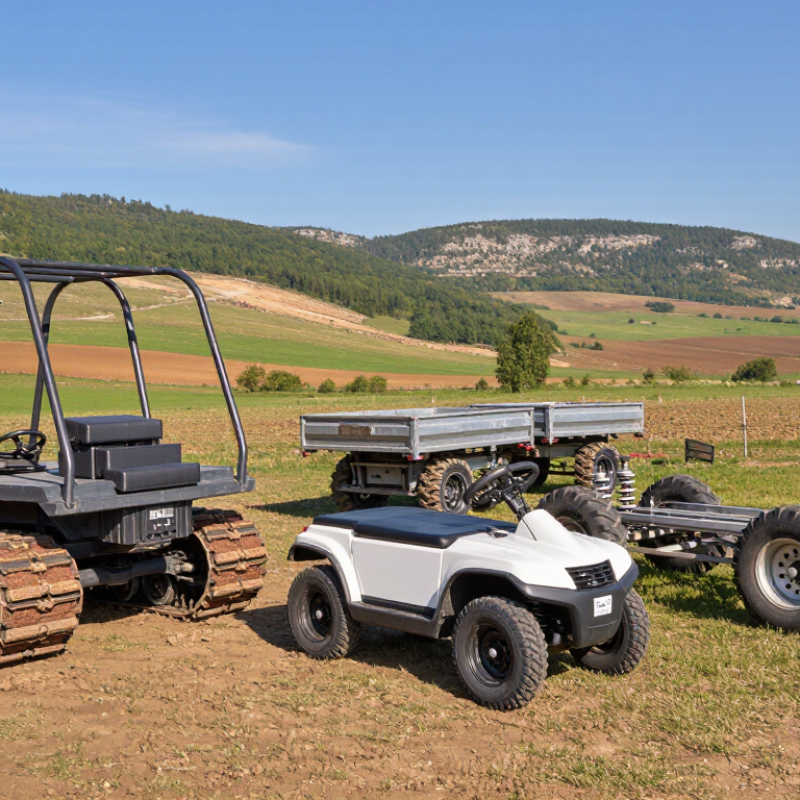
Tracked terrain carts provide stronger grip on sand, snow, and unstable ground. However, they usually move more slowly and may increase maintenance costs. Heavy-duty 4x4 carts perform better on rocky routes and steep access roads, but their larger turning radius can be inconvenient indoors. Electric carts fit warehouses, campuses, and noise-sensitive areas. The U.S. Department of Energy reports that electric drivetrains convert more than 77% of grid energy into movement, compared with about 12–30% for conventional vehicles. This supports lower operating waste, but charging access remains a practical limitation.
The International Energy Agency’s Global EV Outlook 2024 recorded more than 14 million electric car sales in 2023. That figure does not directly measure terrain carts, yet it reflects expanding battery and charging experience. For global buyers, lithium battery carts may suit predictable daily routes, while diesel or hybrid units remain useful where charging is unreliable. A perfect cart does not exist. Even experienced buyers sometimes overestimate climbing ability and underestimate tire damage. Field trials on the actual route are still more reliable than catalog claims.
2026 Best Terrain Cart Types for Global Buyers
Main terrain cart types matched with common operating conditions and representative payload ranges
Tracked utility carts are suited to soft or uneven ground, while 4WD and 6x6 carts are commonly selected for construction, agriculture, forestry, and logistics applications. Payload figures show representative commercial ranges and can vary according to terrain, slope, attachments, and local safety requirements.
Key Features That Improve Off-Road Cart Performance
Off-road cart performance depends less on appearance than on how the chassis manages changing ground conditions. During field evaluations, I check clearance, suspension travel, tire grip, and braking control. High ground clearance protects the underbody from rocks, roots, and deep ruts. Independent suspension improves comfort on uneven trails, while solid axles may offer stronger load support. Neither layout is universally better.
Wide, deep-tread tires can reduce sinking on mud and loose soil. However, oversized tires may increase steering effort and energy use. That trade-off is easy to overlook. Low-speed torque also matters when climbing wet slopes or carrying tools uphill. A controlled differential can limit wheel spin without making turns unnecessarily difficult. Strong hydraulic or sealed electric brakes provide more confidence on descents, especially with a full load.
Weather protection deserves careful inspection. Water-resistant connectors, protected wiring, and sealed battery compartments help during rain and dusty travel. Buyers should verify the cart’s tested water-resistance level rather than trust vague sales language. Payload ratings must include passengers, cargo, and mounted equipment. Do not trust the headline number alone. Seat support, adjustable controls, and clear sightlines reduce fatigue during long workdays. In practical testing, small weaknesses often appear after several hours, not during a short demonstration. A cart may climb impressively yet feel unstable when turning across a slope. That limitation should remain part of the buying decision.
How to Match a Terrain Cart to Your Worksite and Load
2026 Best Terrain Cart Types for Global Buyers
Choosing a terrain cart starts with the worksite, not the advertised payload. Measure slope, ground clearance, turning space, and surface conditions before comparing models. A cart rated for 1,000 kilograms may perform poorly on wet gravel if its tires, drive system, or braking capacity are unsuitable. The Material Handling Institute’s 2024 Industry Report found that 83% of supply-chain professionals view technology investment as a competitive advantage. However, technology cannot replace a proper site assessment.
Match the cart to the real load, including tools, fluids, operators, and uneven weight distribution. For construction areas, low-pressure tires and strong ground clearance help reduce sinking and jolting. Warehouses with ramps may need tighter steering and controlled braking instead. Check the manufacturer’s rated capacity on the steepest planned route, not on flat concrete. OSHA requires powered industrial trucks to carry marked capacity limits, but practical safety needs extra judgment. A neat spreadsheet cannot capture every muddy slope.
Battery capacity also deserves attention. Longer routes, cold weather, and repeated climbing can reduce operating time. I would test the cart during the busiest shift, with the heaviest normal load. That test may expose an uncomfortable truth: the cheapest cart often becomes expensive when it needs recovery, repairs, or repeated charging. Use documented trial results, operator feedback, and maintenance records before making a global purchasing decision.
Global Buying Factors for Terrain Cart Selection in 2026
Global terrain cart buying in 2026 starts with site evidence, not catalogue categories. Map slopes, loose gravel, mud, turning radius, payload, and daily distance. A 4x4 electric cart suits campuses, farms, and wet construction paths. A tracked cart fits steeper, softer ground, but costs more to maintain. A compact utility cart works on mixed surfaces and narrow aisles. The best type depends on failure conditions.
Battery decisions now deserve closer scrutiny. The IEA’s Global EV Outlook 2025 reports that electric car sales exceeded 17 million in 2024. That growth supports wider charging and battery service capacity. However, carts still face colder climates and irregular duty cycles. Compare usable battery capacity, charging time, thermal protection, and replacement access. Ask for measured range with the intended payload. Advertised range can disappoint. A 1,000-kilogram load on a 15-degree slope changes everything.
Reliability should be measured across borders. The World Bank’s Logistics Performance Index 2023 assessed 139 economies and highlighted uneven infrastructure and delivery reliability. Buyers should inspect spare-part lead times, local technicians, tire availability, and corrosion protection. For automated movement, check ISO 3691-4 alignment and documented risk controls. Do not select on purchase price alone. Yet total-cost models can mislead when soil conditions are guessed. A short rental trial, using wet and dry routes, may reveal more than a polished specification sheet.